
Online anonymity explained: What it means and how to improve your privacy



Online anonymity is the ability to stay unknown and unrecognizable on the internet. While true online anonymity is almost impossible to achieve, users can take active steps to protect their identity and increase their privacy.
What is online anonymity?
Online anonymity means limiting how easily your real identity can be linked to your online activity. This can include replacing identifiable details like your name, email address, and phone number, as well as reducing other signals (like IP address and device fingerprint) that could be used to identify you.
It’s similar to wearing a mask online that hides who you are. Others may see your activity, but they’re less likely to link it directly to your real identity.
Online anonymity vs. privacy
Anonymity and privacy are related, but they’re not the same thing:
- Anonymity lets you separate your online activities from your real identity, often through alternate identifiers (like a pseudonym).
- Privacy means keeping your personal data hidden and limiting its presence in the public eye.
In reality, the two concepts often overlap, as anonymity is often part of how people maintain internet privacy. For example, a platform may require a name and email address, but sharing that information reduces your privacy. Using a pseudonym instead lets you access the platform while reducing exposure of your real data.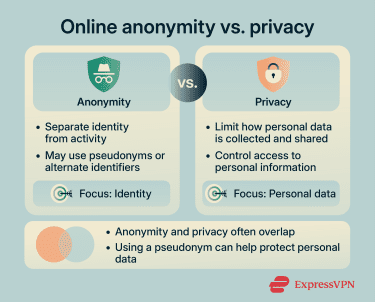
Why is online anonymity important?
Online anonymity matters when linking your identity to your activity could lead to real-world consequences, such as professional risks, safety concerns, profiling, or data collection. It allows you to participate in online activities without revealing your identity; this can include sharing opinions, criticizing organizations or authority figures, or discussing sensitive topics with less risk of backlash.
More broadly, anonymity can reduce exposure to:
- Unwanted scrutiny.
- Restrictions on expression.
- Harassment or cyberbullying.
- Data breaches.
How to improve privacy and reduce exposure online
While complete anonymity isn’t a realistic goal, there are tools you can use to reduce the amount of information that can be linked back to you.
Use a VPN
A virtual private network (VPN) like ExpressVPN can support privacy by masking your IP address and replacing it with the VPN server’s IP address. When you connect to a VPN, websites see the server’s IP address instead of yours. This creates more separation between you and the services you use.
VPN services also encrypt your traffic, which can make monitoring more difficult, especially on public Wi-Fi. Even your internet service provider (ISP) typically can’t see your browsing activity when connected to a VPN (but they can see that you’re connected to one).
However, a VPN doesn’t make you fully anonymous:
- Websites can still identify you through login activity or tracking methods like third-party cookies.
- Your VPN provider may be able to see your real IP address, depending on how its systems are designed.
- Other tracking methods like browser fingerprinting still apply.
Browse with privacy-focused browsers and search engines
Browsers and search engines can collect data that affects your anonymity, especially if they lack strong privacy features. Privacy-focused search engines can reduce tracking by limiting how much query data is collected and associated with users.
The same goes for browsers: standard browsers often allow tracking and telemetry, while privacy-focused browsers reduce this exposure by limiting how much data gets stored, shared, and exposed.
They can:
- Block trackers and ads by default: Some browsers include built-in protections that stop third-party trackers from following you across websites. (Some VPNs, such as ExpressVPN, offer this feature, too.)
- Reduce or remove telemetry: Some browsers limit how much data they send back to the browser developer.
- Limit fingerprinting: For fingerprinting, privacy-focused browsers use protections that reduce, standardize, or randomize exposed browser or device signals.
Limit the personal information you share
Data shared online can be difficult to remove. A social media post or an email address shared with a platform may spread beyond its original context, and limiting what you share helps reduce the risk of identification. Common ways people expose personal information include:
- Posting real names or locations on social media.
- Sharing daily routines or travel plans online.
- Reusing the same usernames across platforms.
- Uploading documents or images with identifiable details on platforms.
These data points can be combined to build a profile of your behavior and may be used to identify you or reveal personal details.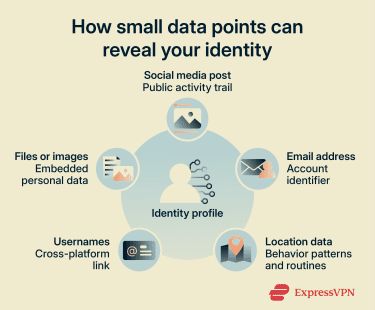
To reduce exposure:
- Share only what’s necessary.
- Avoid posting sensitive details publicly.
- Review your privacy settings.
- Use different usernames across sites and services where possible.
- Limit reliance on smartphones for sensitive activities (as these devices can generate location and usage data that may contribute to profiling).
Additionally, email alias services like ExpressMailGuard can help reduce email tracking and profiling and support account security.
More advanced approaches to anonymity can include using privacy-focused operating systems (like secure Linux distros) or privacy-focused payment methods that limit how much financial information is exposed to merchants (prepaid cards, virtual cards, or tokenized digital wallets).
Avoid common mistakes that reveal your identity
Even with the right tools, small mistakes can reveal your identity and undermine your anonymity. Often, it’s not one action that exposes your data but a pattern of micro-habits.
| Mistake | Effect | Mitigation |
| Mixing anonymous and personal accounts | Can create cross-links based on behavior or session overlap | Keep personal and anonymous accounts separate |
| Using real information in anonymous accounts | Can directly identify you | Avoid using real details in anonymous profiles |
| Allowing tracking and cookies without restrictions | Builds behavioral profiles over time | Use browser privacy settings to limit tracking |
| Using default app privacy settings | Can share more data than intended | Review and adjust settings regularly |
| Maintaining a consistent writing style | Can reveal identity patterns | Avoid reusing profile descriptions or account bios |
Can you be completely anonymous online?
Complete online anonymity is virtually impossible to achieve. If you have any online presence, some entities may be able to link your activity to your identity. For example, your ISP knows your identity, and many services require personal details for delivery or verification.
No single tool can fully separate you from your activity. Even with precautions, small signals like metadata or account activity may still be used to identify you over time.
Anonymity also comes with trade-offs. It may require stricter privacy settings, alternative services, and extra tools, which can affect convenience. The goal is not to eliminate risk, but to reduce exposure in a way that fits how you use the internet.
Legal considerations surrounding online anonymity
Online anonymity is shaped by law as much as by technology. Understanding how anonymity is treated under different legal frameworks helps set realistic expectations.
Is it legal to be anonymous online?
In many countries, being anonymous online is legal and sometimes protected by law. However, there’s no absolute right to anonymity. It can be restricted in specific cases, like crime investigations or reasons of national security. Authorities can sometimes link an IP address to an internet subscriber or network through logs and legal requests, though an IP address alone doesn’t always identify a specific individual.
While anonymity itself isn’t illegal, it’s important to remember that if an activity is illegal, it remains illegal whether someone is anonymous or not. As such, anonymous activity is typically allowed as long as it doesn’t violate the law.
How anonymity laws vary by region
There isn’t a universal legal standard for online anonymity. Laws differ by region and in how they balance privacy, anonymity, freedom of expression, and law enforcement access.
In the U.S., privacy laws are fragmented across different sectors and states, which can affect how personal data is collected and protected. For example, California’s Consumer Privacy Act (CCPA), as amended by the California Privacy Rights Act (CPRA), and the Florida Digital Bill of Rights (FDBR) provide additional protections, including rights over how personal data is accessed, shared, and deleted. However, these protections vary by state, and definitions of personal data and data sharing can differ.
In the EU, data protection and the right to private and family life are fundamental rights that must be protected by public authorities. The General Data Protection Regulation (GDPR) sets obligations for those who control and process personal data and defines individual data rights (like the right of access, erasure, portability, and the right to object to data processing).
How to reduce legal and privacy risks
Reducing legal and privacy risks involves understanding how your data is handled and what rules apply in your region and on the platforms you use:
- Get familiar with what type of data you’re sharing with the services you use. Many platforms collect and process data by default, which they may access or disclose under certain conditions.
- Review platform privacy policies and permissions. Privacy settings and terms of service define how your data is used and when it may be shared.
- Stay aware of local laws and requirements. Data protection and anonymity rules vary by region, and some countries impose stricter requirements than others.
- Avoid relying on anonymity for legal protection, as it doesn’t prevent legal accountability if laws are broken.
The future of online anonymity
The rise and growth of AI have added a significant new factor to the discussion about online anonymity. As AI capabilities grow, traditional data protection and anonymization methods may need to evolve.
Current technology supporting anonymity
Several technologies can support privacy or reduce how identifiable personal data is:
- Anti-fingerprinting techniques: Methods used to make it harder for websites to identify you based on browser and device characteristics (like installed fonts, time zone, operating system, and screen resolution). These techniques can limit the data browsers expose or randomize it and block fingerprinting scripts.
- Differential privacy: Through mathematical functions, differential privacy can add randomness to a dataset. The goal is to make it harder for third parties to identify any single individual in the dataset purely by analyzing the data.
- Fully homomorphic encryption: This allows data to remain encrypted while being processed and used to provide services and products to users. While this addresses a key limitation of traditional encryption (enabling access to the data while limiting exposure of the underlying data), it’s still computationally expensive and not widely used in mainstream systems.
- Secure multi-party computation (SMPC): Helps protect user privacy by allowing services to process sensitive data without directly exposing or centralizing it. This reduces how much raw personal data systems need to store or access, which can lower the risk of exposure through breaches or internal access.
- Zero-knowledge proofs (ZKPs): Allow a user to prove something is true without revealing any underlying personal data or credential details (like proving you have enough funds to complete a transaction without revealing your actual account balance).
Emerging threats to anonymous browsing
Just as pro-anonymity technologies are evolving, so are cyber threats. New threats don’t rely on obvious identifiers like names or IP addresses; they also analyze patterns or behaviors and combine datasets across platforms to uncover user identity.
AI is making it easier to connect pseudonymous online activity to real identities. For example, in February 2026, researchers from the Swiss Federal Institute of Technology (ETH Zurich), Anthropic, and the Machine Learning Alignment and Theory Scholars (MATS) program published a non-peer-reviewed arXiv preprint titled Large-scale online deanonymization with LLMs, which was later covered by various tech media outlets.
Based on their experiments, the researchers claim that LLM-powered systems can analyze public online content at scale, extract identity-relevant clues such as writing patterns, biographical details, posting behavior, and cross-platform references, and use those clues to match pseudonymous accounts to likely real-world profiles.
The study tested this in controlled settings using datasets such as Hacker News and LinkedIn profiles, Reddit communities, and Anthropic interview data, rather than deliberately targeting people who were relying on anonymity in the real world.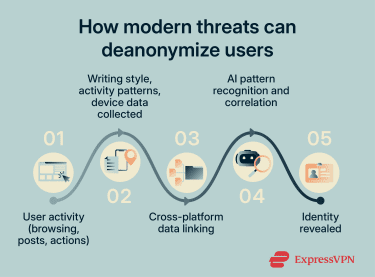
Large-scale data analysis, especially when used as part of government surveillance, could also potentially reduce the effectiveness of anonymity tools. As these systems become a larger part of digital infrastructure, they may normalize monitoring and make anonymity harder to achieve.
Agentic browsers may also have privacy drawbacks. One primary attack vector is prompt injection, where malicious instructions are embedded in external content (such as websites or documents) and interpreted by the AI as legitimate commands. This can lead the system to expose sensitive data or take unintended actions.
Future trends in online privacy and anonymity
Online privacy and anonymity are entering a new phase shaped by rapid technological advances, stricter regulations, and rising user demand for better data control. The future will likely be marked by a balance between advanced tracking and enforcement and more powerful privacy protection tools. Trends include:
- Emphasis on online identity verification: Age verification infrastructure is ready for rollout in the EU, and multiple U.S. states are mandating age verification for adult-content websites. Australia has already banned social media for children under 16.
- Stronger enforcement of privacy laws: Privacy regulations modeled on the GDPR are expanding across the Asia-Pacific (APAC) region and beyond. This means similar principles like data minimization, tighter consent requirements, stronger user rights, and an expansion of enforcement powers.
- Surge in data privacy mass claims: Collective data privacy legal proceedings have grown in number across many jurisdictions. Reasons include growing public awareness of data rights, new laws that codify enforceable data rights, and the emergence of “non-attack” claims that deal with data processed in activities like ad tracking.
- Privacy and anonymity regulated in a platform governance system: Regulators are converging across privacy, consumer protection, cybersecurity, finance, and AI, meaning anonymous or privacy-preserving features may increasingly be judged alongside fairness, safety, and market power instead of purely under privacy laws.
- Stricter standards for anonymous data: Governments are raising the bar for what counts as truly anonymized data. Companies will need stronger privacy protections because basic de-identification will no longer be enough to protect user privacy and anonymity.
FAQ
Does private browsing keep you anonymous?
Can websites still track you if you use a VPN?
What is the safest browser for anonymous browsing?
Can you use social media anonymously?
What are the biggest mistakes that compromise anonymity?
Do cookies affect online anonymity?
Is anonymity online the same for mobile and desktop users?