 Celebrate with up to 80% off
Utah social media law: What parents and teens need to know


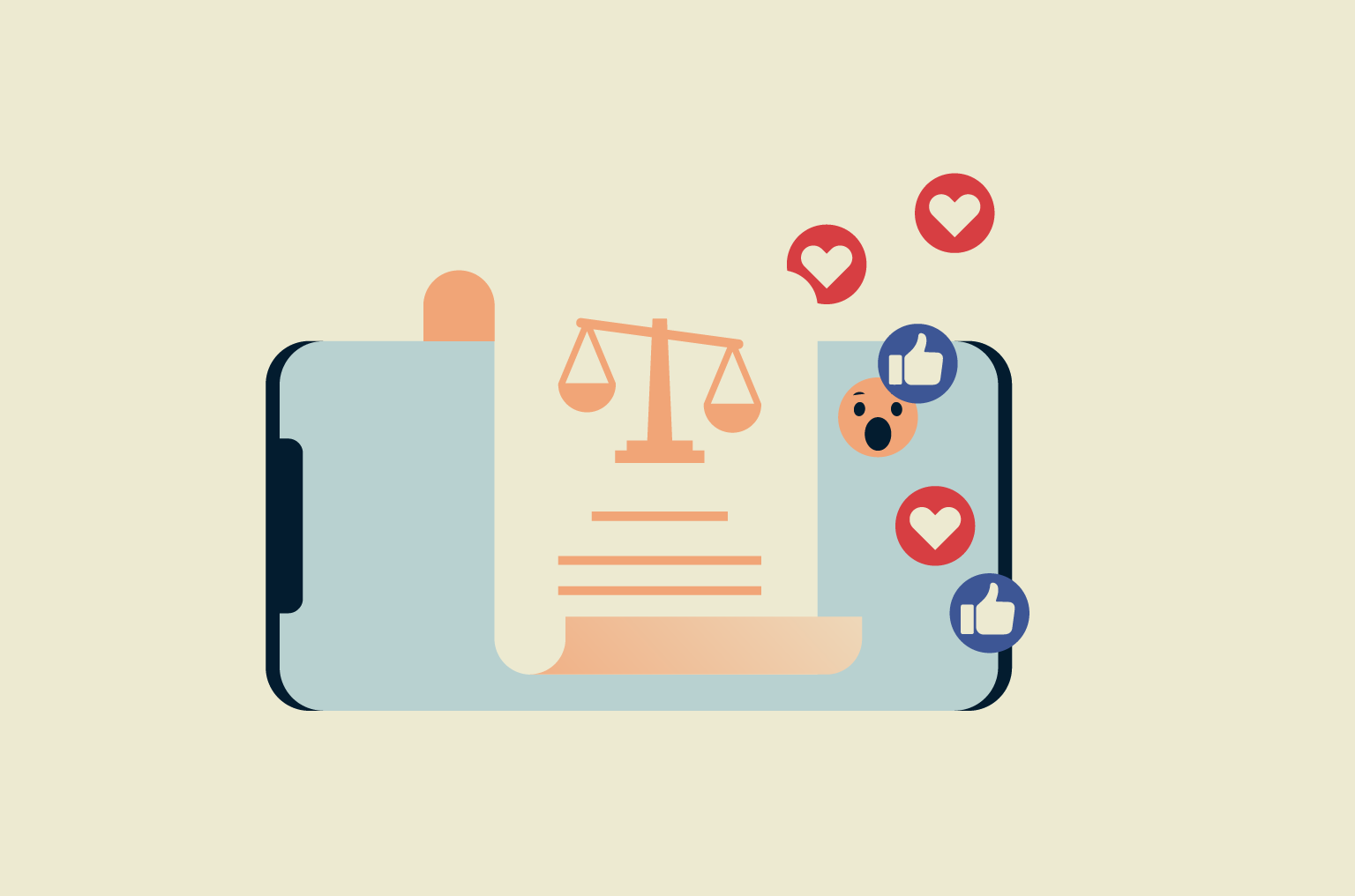
Back in March 2023, Utah passed two bills regulating minors’ use of social media, set to roll out a year later. But after pushback from the public and tech policy advocates, the bills were repealed. In March 2024, Utah replaced the original bills with a revised framework.
The goal behind these laws is pretty clear: help protect children and teens from the downsides of social media, like addiction and mental health issues, while keeping their data safer.
However, a federal judge has blocked Utah from enforcing the updated law, and as of mid-2026, the case is still being debated in court.
In this guide, we’ll walk through what the original law said, what’s changed with the new amendments, and what all of this means for you, whether you’re a parent or a teenager. We’ll also look at what could happen next, since the law’s future is still uncertain.
Please note: This information is for general educational purposes and not legal advice.
What is Utah’s social media law?
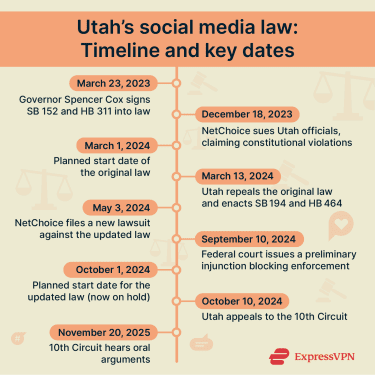
Utah’s social media law started as two bills, Senate Bill 152 (SB 152) and House Bill 311 (HB 311), collectively called the Utah Social Media Regulation Act. They were signed into law with plans to take effect on March 1, 2024.
The main goal of these laws is to protect kids’ online privacy and limit advertising to minors on social media. They also aim to give parents oversight of their children’s social media use.
But before the rollout even began, Utah revised the law with two new bills, SB 194 and HB 464.
Many of the changes made in the amendments were to clarify the rules and address concerns raised by tech policy groups like NetChoice, social media users, and parts of the public who worried about how the original version would work in practice.
Summary of the law’s key provisions
The first version of the law (SB 152) required social media companies to:
- Get parental consent before a minor can open an account.
- Verify the age of both new and existing users.
- Block accounts that don’t go through age verification by the deadline (March 1, 2024).
- Give parents tools to monitor their kids’ accounts.
- Set a default “curfew” for minors, blocking social media use between 10:30 pm and 6:30 am.
- Allow parents to control (set, remove, or modify) the time restrictions on minors’ accounts.
- Block direct messages from people who aren’t on a minor’s friends list.
- Keep minors’ accounts out of search results unless the person searching is already on their friends list.
- Limit data collection on minors to only what’s needed for compliance.
- Stop targeting minors with suggested products, posts, groups, services, or accounts.
HB 311 builds on SB 152 by tackling how social media platforms are designed and used:
- No addiction‑driving features: Social media companies can’t use designs or algorithms intended to get minors hooked on their platforms.
- Right to sue: If a minor is harmed by a social media company’s practices, they (usually through a parent or guardian) can file a lawsuit.
- Compensation: Successful lawsuits can result in at least $2,500 for each incident of harm or the actual damages, whichever is greater.
As already mentioned, before these laws fully kicked in, Utah repealed and replaced them with two new bills: SB 194 and HB 464. These kept most of the core ideas but made some key changes for clarity, including requiring social media companies to:
- Set minors’ accounts to the highest privacy level by default, so their profiles don’t show up in search results except to approved friends.
- Let minors download a full copy of their account data.
- Delete a minor’s account information if requested.
- Turn off features that encourage endless scrolling or binge use, like autoplay, infinite feeds, and targeted push notifications.
HB 464 also added tougher penalties, allowing lawsuits against social media companies with damages starting at $10,000 for each case where social media use led to an adverse mental health outcome.
Who the law applies to
Utah’s social media law affects three main groups: social media companies, minors, and their parents or guardians.
Social media companies face the heaviest obligations. In lawsuits involving minors under 16, there’s a rebuttable presumption, meaning the court assumes the harm claim is valid unless the company can prove otherwise. To fight these claims, platforms must show they used reasonable measures to:
- Verify users’ age.
- Obtain verifiable parental consent before allowing minors to open accounts.
- Limit addictive features (like endless scrolling and autoplay).
- Provide parental tools to manage account privacy and safety.
Parents and guardians gain more control and insight into their children’s online activity. They must approve account creation for minors and can see details like connected accounts, blocked users, privacy settings, and general usage data.
Minors get stronger privacy and safety by default, like higher privacy settings and safer default features. However, they can’t just sign up for social media on their own and may see their reach limited since accounts don’t appear in public searches unless the person searching is already a connection.
That’s why some activists and social media users argue that the law limits minors’ freedom online, putting more control in parents’ and platforms’ hands rather than the minors themselves.
Why the law was introduced in Utah
Utah lawmakers give several reasons for pushing these social media regulations, focusing on data privacy risks, social media addiction, and mental health concerns among minors.
For one, SB 194 highlights how social media platforms collect and use massive amounts of personal data, including from minors. Lawmakers worried this data could be misused or put teens at risk of privacy breaches and identity theft, an especially big deal given how sensitive digital data has become.
Another driver was the addictive nature of social media, which can affect teens’ sleep patterns, mental well‑being, and even school performance. Utah legislators pointed to research showing links between heavy social media use and anxiety, depression, and other negative health outcomes. ExpressVPN’s research also speaks to this concern, finding that 86% of Gen Z social media users (ages 16–24) say social media directly impacts their happiness.
There’s also a cultural and political aspect: Utah has a history of passing family‑oriented, youth‑protection legislation, and many lawmakers felt existing parental control tools from social media companies weren’t enough. They argued that parents needed stronger default protections and more visibility into what their kids do online.
All of this combined created a push for stricter oversight of how teens access and interact with social media, something Utah positioned itself as a leader on compared to other U.S. states.
When does the Utah social media law go into effect?
Utah first passed two social media laws (SB 152 and HB 311) that were set to take effect on March 1, 2024. Before that date arrived, lawmakers repealed them and introduced two new bills (SB 194 and HB 464) with the goal to implement them on October 1, 2024.
However, in September 2024, a federal judge granted NetChoice (a tech-industry trade association) a preliminary injunction, arguing the law likely violates the U.S. Constitution. This injunction prevents the law from being enforced while the case proceeds, and Utah appealed the ruling to the U.S. Court of Appeals for the 10th Circuit. The appeals court heard oral arguments on November 20, 2025, but as of late June 2026, no decision has been issued. The case is now known as NetChoice v. Brown, after Derek Brown took office as Utah's new attorney general.
How will it be implemented technically?
Because the law is currently blocked, we haven’t seen exactly how social media companies would roll it out. Still, based on HB 464, SB 194, and the recently passed App Store Accountability Act (SB 142), which was itself challenged in court, though the complaint was later withdrawn, we can make a pretty good guess at what it might look like.
SB 142’s provisions require app store providers (like Google Play Store and Apple App Store) to verify user age, as long as the user accesses the app store while in Utah. If the user is determined to be a minor, the app store provider must then:
- Obtain parental consent before allowing the minor to download or purchase an app or make any in-app purchases.
- Link the minor’s account to a parent/guardian account that allows for monitoring and oversight.
So, if HB 464 and SB 194 were implemented, platforms would first need to know if someone is in Utah, most likely by checking their IP address.
Next comes age verification. Companies would probably have to confirm users’ ages using a government‑issued ID or another “commercially reasonable” method, similar to what’s already required under other U.S. age‑verification laws.
If a user turns out to be a minor, the platform would need to switch them to a “youth‑safe” version of the app: private profiles by default, no direct messages from strangers, no endless scrolling or autoplay, and no targeted recommendations or extra data collection.
All this could mean social media platforms end up building a separate experience just for minors in Utah, and possibly in other states if similar laws catch on.
What are the criticisms of the Utah social media law?
When U.S. District Judge Robert Shelby issued the temporary injunction against Utah’s social media law, he acknowledged the state’s good intentions, saying the court “recognizes the State’s earnest desire to protect young people from the novel challenges associated with social media use.” But that hasn’t stopped critics from pointing out some issues with how the law works.
Free speech concerns
One of the biggest criticisms centers around the First Amendment, which protects freedom of speech, religion, the press, and assembly. It generally extends to minors, giving them most of the same rights as adults.
That’s why NetChoice, a trade group representing major tech companies like Google, Meta, and Discord, was able to secure an injunction. Their lawsuit argued that Utah’s law regulates “the protected speech of social media companies and their users.”
Here’s an example: imagine a 16‑year‑old student trying to post about unfair treatment or injustice at their school. Because of the law’s restrictions, their posts might not reach anyone beyond their approved friends list. Instead of raising awareness or sparking change, their voice could be effectively silenced, which is something many see as a violation of their First Amendment rights.
Privacy and data collection risks
Another concern critics raise is privacy. Many people use social media anonymously. This could be to avoid harassment, protect their identity as part of a marginalized community, or simply because they value their privacy.
But under Utah’s law, platforms would need to collect personal information to verify a user’s age. In most cases, that means providing a government-issued ID or other personally identifying documents, and in some systems, even biometric data like facial recognition.
Even if social media companies promise not to use this data for anything beyond age checks, it still has to be stored somewhere. That increases the risk of data breaches, putting highly sensitive personal information in jeopardy.
Disproportionate impact on marginalized groups
Some critics also point out that the law could unintentionally harm some of the kids it’s meant to protect, especially those from marginalized groups like LGBTQ+ youth or teens involved in causes their parents don’t support.
Because the law gives parents and legal guardians full access to their child’s social media activity, it could stop these kids from reaching out to online support groups or safe communities where they can find help and understanding.
The risk is even higher for kids in abusive households. First, they need a parent’s consent just to create a social media account. And if they do get that permission, the parent would still be able to see who they talk to online, including abuse hotlines or support networks they might desperately need.
Learn more: Find out how to stay private online as a member of the LGBTQ+ community.
Technical and logistical challenges for platforms
One of the biggest hurdles is figuring out how to actually implement this law. There’s no clear roadmap, and every social media platform works differently, making it hard to apply one set of rules across the board.
The law also puts a lot of pressure on companies to make these changes quickly and correctly. If they fail, minors (or their parents) can sue, and the burden of proof falls on the companies to show they complied.
Even established and highly developed platforms like YouTube, which already has a dedicated kids’ app (YouTube Kids), admit that some inappropriate content can still slip through. That highlights how complicated it is to filter and monitor content perfectly. Some experts worry that, rather than taking on the risk and cost, platforms might just pull their services from Utah entirely rather than try to meet the law’s requirements.
How does Utah’s law compare to other states?
Utah isn’t the only state trying to restrict minors’ use of social media, but these laws are at very different stages. Some are currently enforceable, some are partly blocked, some are stayed while courts review them, and others never became law.
Florida (HB 3)
Unlike Utah’s law, Florida’s HB 3 is currently enforceable while the constitutional case continues. The law requires social media platforms to terminate accounts held by users under 14 and obtain parental consent before allowing 14- and 15-year-olds to open or keep accounts. It also allows minors and parents or guardians to request account deletion.
Ohio (Parental Notification by Social Media Operators Act)
Ohio’s law requires social media platforms to get parental consent before allowing children under 16 to create accounts. It was initially blocked, but in June 2026, the 6th Circuit reversed that decision and allowed the law to be enforced while the legal challenge continues. Like Florida, Ohio’s law is still being litigated, so its status could change, but it currently belongs in the “enforceable” category.
Texas (HB 18)
Texas’s SCOPE Act is partly in effect, but key provisions are blocked by court injunctions. The law is designed to limit social media companies’ collection of minors’ data, restrict targeted advertising to minors, reduce minors’ exposure to certain harmful content, and provide parental tools. However, courts have paused parts of the law, including provisions related to content filtering, advertising restrictions, and age-verification rules. Texas has appealed the ruling.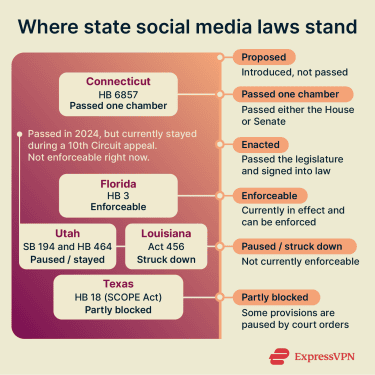
Louisiana (Act 456)
Louisiana's Act 456 would have required parental consent for minors to open social media accounts and included other restrictions on minors’ social media access. However, a federal court permanently blocked Act 456 in NetChoice v. Murrill, finding it unconstitutional on First Amendment grounds.
Connecticut (HB 6857)
Connecticut considered a similar bill in 2025. HB 6857 passed the state House of Representatives and would have required parental consent before minors could access personalized, algorithm-curated social media feeds. However, the bill stalled in the Senate before the legislative session ended, so it did not become law.
Could this become a national trend?
Utah’s law is part of a wider shift in how people talk about kids and social media. Parents, educators, researchers, and lawmakers are becoming more aware of the ways platforms can affect children’s privacy, attention, sleep, mental health, and exposure to harmful content. That growing concern is likely to keep pressure on governments to act, even if specific laws continue to face legal challenges.
But awareness does not automatically lead to good policy. The laws discussed above are trying to address real problems, yet they can also create new ones. Age verification may push platforms to collect more sensitive data from everyone, including adults. Parental-access rules may reduce privacy for teens who use online spaces to seek support, especially in unsafe or unsupportive homes. And broad restrictions can affect young people’s ability to communicate, organize, learn, or express themselves online.
So while more states may follow Utah’s lead, the bigger question is not simply whether these laws spread. It’s whether they actually make young people safer without expanding surveillance, limiting access to information, or weakening privacy. A national approach may eventually emerge, but it would need to balance child safety with free expression, anonymity, data security, and teens’ own rights online.
FAQ: Common questions about Utah social media law
Is Utah banning social media for kids?
No, Utah isn’t outright banning social media for kids. Instead, it passed a law requiring anyone under 18 to get parental consent to use social media and setting strict rules for how minors can use these platforms. However, the law is currently blocked by a federal court and isn’t being enforced.
What is the age limit under Utah’s social media law?
Utah’s social media law sets the age limit at 18. However, the amended Utah social media law defines a minor as an individual under 18 who hasn’t been married or emancipated from their parents. If they have, the age limit no longer applies to them, and they stop being considered a minor.
What happens if platforms don't comply with the Utah social media law?
Social media companies that break Utah’s social media law can face fines of up to $2,500 per affected minor for each violation and may have to give up any profits made from breaking the rules. Under HB 464, penalties are even tougher: minors (through their parents or guardians) can sue and seek damages starting at $10,000 for each case where social media use caused an adverse mental health outcome.