
Expressvpn Glossary
Data custodian

What is a data custodian?
A data custodian is a person responsible for the technical management and protection of an organization’s data assets. They ensure that data is stored securely, remains accessible to authorized users, and is maintained in accordance with policies set by data owners and governing bodies.
See also: Data governance framework, data access, data protection policy, data integrity
Core responsibilities of a data custodian
Within a data governance framework, a data custodian operates at the technical layer, implementing and maintaining the systems that enforce data policies defined by data owners and stewards. They translate governance requirements into practical controls and ensure those controls continue to function as intended over time.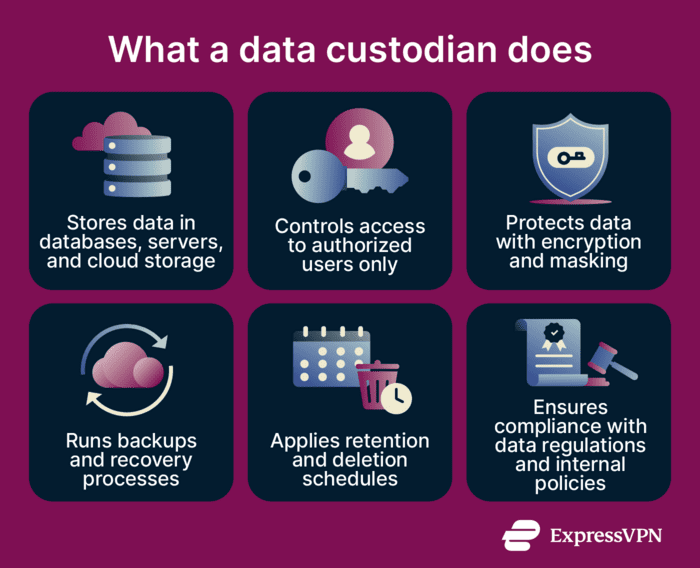
- Maintaining data systems: Managing databases, servers, or storage environments where organizational data is stored and processed.
- Ensuring data security: Applying encryption at rest and in transit, and monitoring for unauthorized access.
- Applying access controls: Implementing permissions and identity controls so that only authorized users can view or modify specific data.
- Handling backup and recovery: Ensuring data is regularly backed up and can be restored if systems fail, data is lost, or a cyber incident occurs.
- Enforcing storage and retention policies: Managing how long data is stored and ensuring outdated or unnecessary data is archived or deleted according to policy.
- Coordinating with data owners and other teams: Working with governance, security, and IT teams to ensure that technical controls align with organizational data policies and broader regulations.
Why are data custodians important?
Data custodians play a key role in protecting and managing an organization’s data at the technical level. They help reduce the risk of data breaches, operational disruptions, and compliance issues by making sure systems are maintained, data is available, and data handling policies are adhered to.
Data custodian vs. data owner vs. data steward
Organizations often divide data governance responsibilities among several roles. While these roles work together closely, each focuses on a different aspect of managing and protecting data.
In simple terms: the data owner sets the rules, the data steward ensures rules are followed and data is reliable, and the data custodian implements the technical systems and safeguards to support those rules.
| Role | Primary focus | Key responsibility |
| Data owner | Accountability for a data asset | Specifies the usage of data, access permissions, and the governing policies. |
| Data steward | Data quality and oversight | Guarantees that data is accurate, consistent, and utilized in line with governance standards. |
| Data custodian | Technical management of data systems | Oversees the systems that store data and puts in place controls to protect and manage it. |
Further reading
- What is access control? How it works and why it matters
- Zero-trust data protection explained
- Privacy engineering explained: How to build products people can trust
- What is security posture? A complete guide for organizations