 Celebrate with up to 80% off
Is G2A safe? What you need to know before buying game keys


G2A often lists game keys at prices far below official stores. A $60 new release listed for $18 can look like a great deal, but it also raises some fair questions. Why are some digital game keys so cheap? What happens if a key doesn’t work? And most importantly, is buying on G2A really safe?
The honest answer is that it depends. G2A is a marketplace, not a retailer. It connects buyers with independent sellers, so your experience depends heavily on who you buy from. Millions of people use G2A without incident, but compared to buying from official stores, there are extra risks you should understand before clicking “buy.”
What is G2A, and how does it work?
G2A is a legitimate online marketplace for game keys and other digital products like software licenses, subscriptions, online courses, and gift cards. It doesn’t sell anything itself. It’s more like eBay or Amazon Marketplace: thousands of independent sellers list products, and G2A handles the listings, payments, and messaging that sit on top.
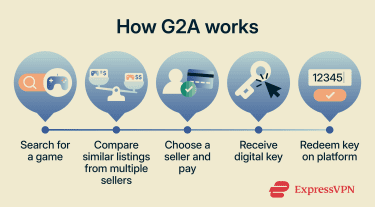
When you buy a key (a code that unlocks a game on a specific platform) on G2A:
- You choose a seller listing.
- You complete the payment through G2A.
- The seller provides a digital code.
- You redeem that code on the relevant platforms like Steam, Xbox, or PlayStation.
 Sellers set their own prices, which is why the same key can have ten different listings at ten different prices, all on the same page.
G2A vs. official stores
Official stores like Steam or the PlayStation Store sell keys directly. The publisher sets the price, the store takes the payment, and the key is generated for that specific sale. If something goes wrong, there’s clear customer support, and refund policies are defined.
On G2A, the keys come from third-party sellers who bought them somewhere else first. The keys themselves are genuine, but the chain of ownership is longer, and so is the list of things that could go wrong. Support depends on both the seller and G2A’s dispute system.
This difference is the main reason prices are lower and why risk is higher.
Who sells on G2A?
Sellers on G2A are generally verified business sellers, including retailers, wholesalers, and in some cases developers or publishers. Some operate at a much larger scale than others, which is why listings for the same product can vary widely in price and volume.
To register as a seller, G2A requires business verification, including ID and tax documentation. It also builds public ratings from buyer feedback over time. Top performers can earn an “Excellent Seller” badge, which is the easiest visual shorthand for a reliable account.
While G2A asks sellers for purchase documentation, it doesn’t seem to independently audit where each key came from before it gets listed. That’s the gap where most buyer problems live.
Is G2A safe and legitimate?
The short answer: yes on both accounts, but with important caveats.
Legally, G2A is a registered company operating out of Hong Kong, with its Polish subsidiary handling customer support. It was started in 2010, processes payments through standard financial rails such as Visa, Mastercard, PayPal, and Venmo, and complies with the usual consumer protection frameworks. Using it anywhere it operates isn’t illegal, and buying a key from the platform isn’t breaking any laws.
In practice, the safety of each purchase depends almost entirely on the seller, not the platform. Most transactions go through without a hitch. However, some don’t, and when they don’t, some users have reported a slow and inconsistent resolution process.
That distinction (the platform is legitimate, but not every seller is equally reliable) explains why opinions about it are so mixed. G2A has faced criticism from some developers and publishers over the years, largely around revenue and key sourcing, as games sold through third-party resale channels may not always generate income for the original creators.
G2A has responded with several initiatives, including G2A Direct (a loyalty program offering developers up to 10% of resale revenue if they opt in) and an offer to pay developers 10 times any chargeback losses they could prove were tied to fraud on G2A.
Why are G2A prices so low?
G2A is a third-party marketplace rather than a traditional official game store. Usually, the price differences come down to three things.
Regional pricing differences
Publishers price games differently across regions. A game that costs $70 in the U.S. might sell for the local equivalent of $25 in another country due to local market conditions and purchasing power.
Some sellers on G2A take advantage of this by buying keys in lower-priced regions and reselling them in higher-priced markets. Buyers get a discount compared to their local official store price, and the seller makes a profit.
While the key itself may be genuine, it may be region-locked, meaning it can only be activated on an account registered in the region it was bought in. Check the listing carefully before buying.
Bulk buying and bundles
Some sellers buy thousands of keys from:
- Discount sales
- Promotional bundles
- Wholesale deals
They can then resell them at a markup that’s still well below the retail price.
Fraud and chargebacks
This is the uncomfortable one. A small but real share of keys may have been originally purchased with stolen credit card details. The fraudster buys in bulk from an official store and lists the keys for a quick profit before the fraudulent transaction is identified.
When the bank reverses the original payment weeks later, the publisher revokes the key, and the person who bought it in good faith loses access.
The ethical debate
Supporters of platforms like G2A argue it’s not so different from selling a second-hand book or a used CD: once a key is sold, the publisher is paid, and what happens next is up to the owner. Proponents also argue that:
- Buyers benefit from lower prices.
- Reselling is common practice in many markets.
Critics counter that the comparison doesn’t really hold because digital keys don’t work like physical goods: there’s no wear and tear, no finite supply, and hence no reason why a developer should expect a second sale to undercut their first. Common developer concerns include:
- They may not receive revenue from resold keys.
- Pricing strategies can be undermined.
- Unauthorized resale can disrupt partnerships with official distributors.
This debate is why platforms like G2A have a mixed reputation. While the marketplace itself is legal, the way products move through this and similar platforms raises questions about fairness and long-term impact.
Potential risks of buying from G2A
Most G2A purchases are uneventful. But compared to buying from an official store, there are specific risks worth understanding, most of which stem from the nature of the marketplace rather than G2A as a company.
Invalid or revoked keys
One commonly reported issue on G2A is receiving a key that doesn’t work or stops working later. This can happen if:
- The key was sold to multiple buyers and has already been redeemed by someone else.
- The key was never valid to begin with.
- The publisher disables the key after the original purchase is flagged as fraudulent.
The third case is the hardest to catch because the key looks legitimate at activation and works fine for days or weeks. Then one day, it stops working when the underlying transaction is reversed.
Refunds are not straightforward
G2A itself isn’t the seller, so it generally doesn’t issue direct refunds. Each seller sets their own return policy, and the first step in any dispute is to open a conversation with them via G2A’s platform and provide evidence like screenshots or error messages.
Sellers can issue refunds within the conversation panel, either as a full refund or a replacement product. However, if they haven’t responded within seven days, you can escalate to G2A’s support team.
However, the platform’s documentation doesn’t specify a clear resolution timeline or guarantee an outcome when a seller fails to respond. Outcomes vary, and resolution is not guaranteed.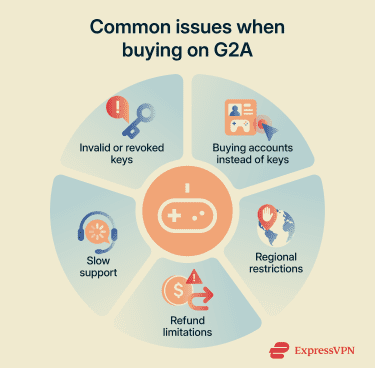
Account or region issues
Some keys only activate on accounts registered in a specific country or region. Common region labels you’ll see on listings include:
- Global or Rest of World (RoW): Usually, most countries, but can include certain exemptions.
- RU or CIS: Russia and the Commonwealth of Independent States.
- LATAM: Latin America.
If you buy an RU key while living in the UK, you won’t be able to activate it, even though the key itself is technically valid. G2A generally indicates regional compatibility; however, it’s important to check the full listing for any exclusions.
Buying accounts instead of keys
Listings sometimes sell full accounts (pre-made login credentials) for platforms like EA instead of game keys. Accounts typically violate the terms of service of major gaming platforms like Steam, can be reclaimed by the original owner at any time, and leave you with nothing when they stop working.
Always check whether you’re buying a key or an account before paying.
How to buy safely on G2A
None of these tips is a guarantee, but they can help reduce risk significantly:
- Only buy from highly rated sellers: Look for sellers with a large number of sales and high ratings. Check the recent reviews, not just the overall score. A seller whose rating has been slipping in the past few weeks can signal a change in the quality or source of their keys and is a bigger worry that one with a few old complaints and a long, solid history.
- Look for the Excellent Seller badge: It’s not foolproof, but badged sellers have met G2A’s higher performance thresholds, and they’re a safer place to start than an unknown.
- Read the listing for region and platform: Both details are on the product page. Check the listing details carefully to make sure they both match.
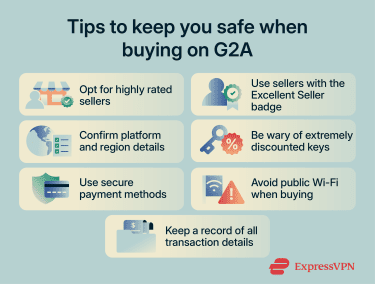
- Compare prices on G2A: If one listing is significantly lower than comparable listings on G2A itself, not just lower than official stores, treat it as higher risk. Extreme discounts could indicate a problem with the key's origin or validity.
- Use a secure payment method: Credit cards and PayPal both offer buyer protection rights that work independently of G2A. Direct bank transfers and mobile payment apps give you far fewer options if something goes wrong.
- Avoid public Wi-Fi: Use a secure connection when making purchases. If you can’t wait until you’re on a trusted network, use a reputable virtual private network (VPN) to encrypt your traffic and protect your payment and login information from being exposed.
- Keep proof of purchase: Save your order confirmation, receipts, and any communication with the seller. Having a ready paper trail makes it easier to escalate any disputes through G2A's support process or your payment provider.
Bottom line: Should you buy game keys from G2A?
G2A works well for a particular kind of buyer. It offers clear advantages in price and availability, but it doesn’t provide the same level of consistency as official stores.
G2A makes sense if you:
- Are budget-conscious and looking for lower prices.
- Are willing to check seller ratings carefully.
- Understand region locks and how they affect activation.
- Can use a credit card or other secure payment method in case something goes wrong.
- Are buying spare copies or games you’re not deeply attached to.
You may want to avoid G2A if you:
- Are buying a high-value or brand-new release, where losing access later would really hurt.
- Want consistent, predictable support.
- Aren’t comfortable troubleshooting a dispute yourself.
FAQ
Is G2A safe for credit cards?
Does G2A refund your money?
Can you get banned for using a G2A key?
Is G2A safe for Steam keys?
Is G2A legal?
Is G2A worth it?