 Celebrate with up to 80% off
Block cipher vs. stream cipher: How they work and when to use each


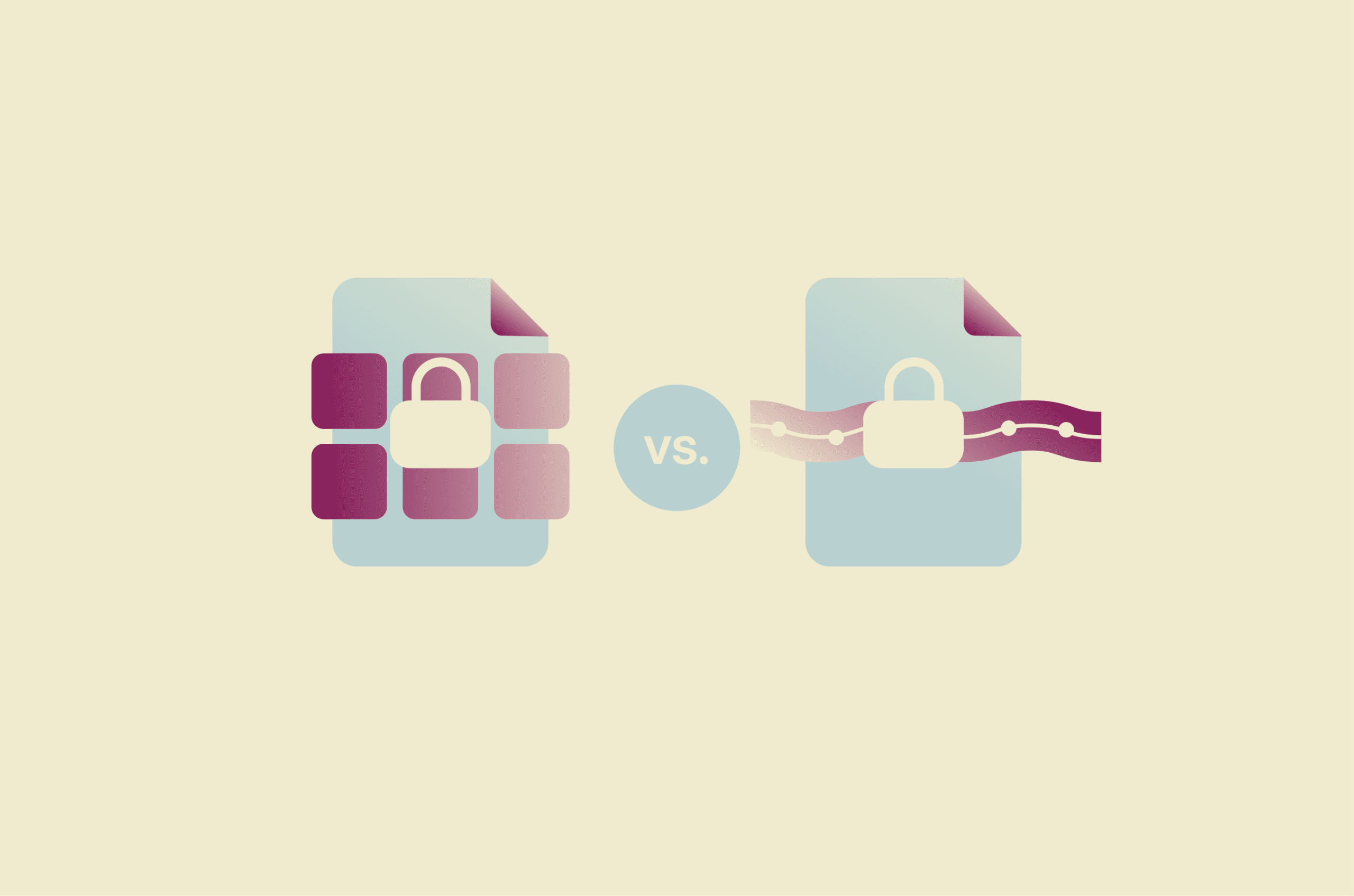
Block and stream ciphers are the two main families of symmetric ciphers used for encryption. They use the same cryptographic key to encrypt and decrypt data, but they process it differently. That difference affects speed, resource use, error handling, and how each cipher works in real-world systems.
Modern encryption relies on both approaches. Block ciphers are widely used to secure stored data and structured messages, while stream ciphers are useful for fast, real-time communication and low-latency connections.
How do block ciphers work?
A block cipher works by encrypting data in fixed-size chunks called blocks. During each encryption cycle, the cipher processes one full block of plaintext. If the final block is too short, some modes add padding, which is extra data used to fill the block to the required size.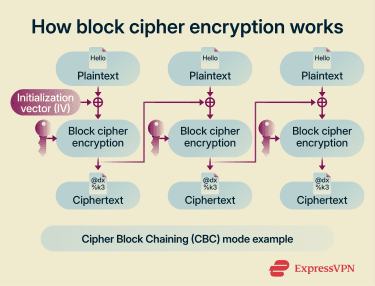
Block ciphers usually protect data through repeated rounds of transformation. Each round changes the plaintext in a controlled way, helping hide patterns that could reveal information about the original data.
Different block ciphers use different designs, such as substitution permutation networks (SPNs) or Feistel structures, to make the ciphertext difficult to interpret or reverse without the correct key.
During decryption, the key reverses the process and restores the original plaintext.
Block cipher modes
Block cipher modes define how a block cipher handles data across multiple blocks. The mode affects performance, error handling, repeated data patterns, and whether the encryption process can also check for tampering.
Note: Modes that use an initialization vector (IV) or nonce depend on those values being generated and handled correctly. Reusing an IV or nonce with the same key can weaken security, and in some modes, it can create serious vulnerabilities.
- Electronic Codebook (ECB): ECB encrypts each plaintext block independently using the same key, without an IV or chaining between blocks. This makes ECB simple and easy to process, but it also means identical plaintext blocks produce identical ciphertext blocks, which can reveal patterns in the data.
- Cipher Block Chaining (CBC): CBC combines each plaintext block with the previous encrypted block before encrypting it. The first block is combined with an IV, so encrypting the same plaintext with the same key produces a different ciphertext when a different IV is used. This reduces repeated ciphertext patterns, but CBC requires sequential processing.
- Cipher Feedback (CFB): CFB turns a block cipher into a stream-like mode by encrypting the previous ciphertext block and combining the result with the next plaintext segment. For the first segment, CFB encrypts the IV instead. This lets CFB handle smaller amounts of data, but errors may spread between blocks.
- Output Feedback (OFB): OFB encrypts the previous output rather than the ciphertext, creating a stream of data that’s combined with the plaintext. This reduces error propagation, but the sender and receiver must stay synchronized.
- Counter Mode (CTR): CTR encrypts incrementing counter values to create a stream of data that’s combined with the plaintext. It’s fast and supports parallel processing.
- Galois/Counter Mode (GCM): GCM builds on CTR mode by adding authentication and integrity checks. This means it can protect data confidentiality and help detect tampering. It’s more complex to implement correctly, but it’s widely used in HTTPS and modern secure protocols.
- Counter with CBC-MAC (CCM): CCM combines CTR encryption with CBC Message Authentication Code (CBC-MAC). This lets it protect both confidentiality and integrity, though it can be slower than GCM in some environments.
Common block cipher algorithms
Several block cipher algorithms have shaped modern encryption standards. Advanced Encryption Standard (AES) is the dominant choice today, while others are mostly found in older systems, specialized tools, or legacy compatibility settings.
- AES: AES uses a 128-bit block size and supports 128-bit, 192-bit, and 256-bit keys. Many governments, financial institutions, virtual private network (VPN) services, and cloud platforms use AES because it offers strong security and efficient performance in both hardware and software.
- Blowfish: Blowfish is a symmetric block cipher that encrypts 64-bit blocks and supports key sizes up to 448 bits. It was designed as a faster alternative to the Data Encryption Standard (DES), but AES has largely replaced it in modern systems. Its smaller block size makes it less suitable for encrypting large amounts of data.
- Twofish: Twofish encrypts 128-bit blocks and supports key sizes up to 256 bits. It was a finalist in the AES selection process and is known for its flexible design, but it’s less commonly used than AES today.
- Serpent: Serpent uses 128-bit blocks and supports keys up to 256 bits. It was also an AES finalist and was designed with a conservative security margin. It’s not as common as AES, but it may appear in systems that prioritize cautious encryption design over speed.
- Triple DES (3DES): Triple DES improves on the original DES algorithm by applying the encryption process three times. It uses 64-bit blocks and supports key lengths up to 168 bits. However, it’s slower and less efficient than AES, and it’s now mainly associated with legacy systems.
Advantages and disadvantages of block ciphers
Block ciphers remain one of the most trusted encryption methods in modern cybersecurity. They provide strong protection for stored and structured data, but their performance and security can vary depending on the algorithm, cipher mode, and implementation.
Advantages
- Strong security when implemented correctly: Modern block ciphers like AES, combined with properly managed keys, are resistant to many common cryptographic attacks.
- Well-suited to stored and structured data: Block ciphers work well for encrypting large files, databases, backups, and other data that can be processed in defined blocks.
- Support for authenticated encryption: Modes such as GCM can provide both confidentiality and integrity, helping protect data and detect tampering.
- Hardware acceleration: Many modern processors include built-in support for faster AES encryption, which can improve performance.
Disadvantages
Block ciphers also have limits. Their security and performance depend heavily on the mode of operation, implementation quality, and how keys and initialization values are managed.
- Some modes add complexity: Modes that require padding can create security issues if padding is handled incorrectly.
- Weak modes can expose patterns: ECB, for example, can reveal patterns because identical plaintext blocks produce identical ciphertext blocks.
- Some modes limit performance: Modes that require sequential processing can be slower because each block depends on the one before it.
- Performance varies by setup: Speed depends on the algorithm, mode of operation, implementation quality, and hardware support.
- May add latency in real-time systems: Some block cipher modes may be less suitable for low-latency communication than lightweight stream ciphers.
Use cases for block ciphers
Block ciphers work best when systems need strong protection for stored or structured data.
Common use cases include:
- File encryption.
- Full disk encryption.
- Secure cloud storage.
- Database protection.
- VPN encryption protocols.
- Backup encryption.
- Financial transactions.
Many modern VPN protocols rely on AES block cipher encryption because it provides strong security and performs efficiently on modern hardware.
How do stream ciphers work?
A stream cipher encrypts data one bit or byte at a time by combining plaintext with a continuous pseudorandom keystream. This means it doesn’t need to divide data into fixed-size blocks or add padding before encryption.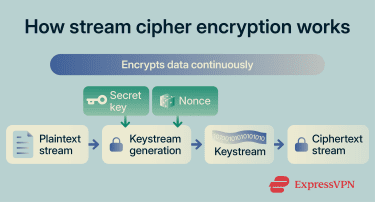
Stream ciphers are designed for situations where data moves continuously. Because they encrypt data incrementally, they typically introduce less delay than block ciphers and require fewer system resources, especially in pure software implementations without AES hardware acceleration.
The process usually starts with a shared secret key and a unique nonce or IV. The nonce helps the cipher generate a different keystream for each encryption session, so it can’t be reused with the same key.
Once initialized, the cipher produces a pseudorandom stream of bytes called the keystream. The plaintext combines with this keystream, usually through an exclusive OR (XOR) operation, to create the ciphertext.
During decryption, the receiver uses the same secret key and nonce to regenerate the identical keystream. Combining that keystream with the ciphertext restores the original plaintext.
Common stream cipher examples
Several stream ciphers have played major roles in modern cryptography, though some older algorithms are now considered insecure.
- ChaCha20: ChaCha20 is one of the most widely used modern stream ciphers. It was designed as a faster, lightweight alternative to AES in software environments and performs especially well on mobile devices and lower-powered hardware. Modern VPNs, Transport Layer Security (TLS) connections, and secure messaging apps commonly use ChaCha20 today.
- Salsa20: Salsa20 is the predecessor to ChaCha20. It gained recognition for its speed, efficiency, and resistance to timing attacks. Salsa20 and its variants still appear in some secure messaging and embedded systems.
- Rivest Cipher 4 (RC4): RC4 was one of the world’s most widely used stream ciphers and appeared in older Secure Sockets Layer (SSL)/TLS and Wi-Fi security protocols. Its popularity came from its simplicity and speed, but researchers later discovered major vulnerabilities that made it unsafe for modern use. Most organizations have now deprecated RC4.
- Software-optimized Encryption Algorithm (SEAL): SEAL is a software-optimized stream cipher designed for 32-bit processors and systems with sufficient memory resources. It uses a 160-bit key and generates a pseudorandom keystream for fast encryption in software environments.
Advantages and disadvantages of stream ciphers
Stream ciphers are designed for fast, continuous encryption with minimal delay. They perform especially well in real-time communication systems and low-resource environments, though their security depends heavily on correct implementation and nonce management.
Advantages
The main benefit of stream ciphers is efficiency. Because they encrypt data as it arrives, they can work well in systems where responsiveness or limited processing power matters.
- Fast encryption with low latency: Stream ciphers process data as it arrives, which can make them efficient for real-time communication.
- Efficient for continuous data flows: They work well for real-time audio, video, and other traffic where data moves in a steady stream.
- Suitable for low-power devices: Their lightweight design can work well on resource-constrained devices.
- No fixed block size or padding required: Stream ciphers encrypt data continuously, so they don’t need to divide plaintext into fixed-size blocks.
- Lower computational overhead: Some stream ciphers require fewer resources than block ciphers, depending on the algorithm and implementation.
Disadvantages
Stream ciphers are sensitive to implementation mistakes. Their security depends heavily on proper key, nonce, IV, and keystream management.
- Nonce reuse can expose data: Reusing the same key and nonce can reveal information about the plaintext.
- Incorrect IV handling can create vulnerabilities: Poor nonce or IV management can weaken the encryption.
- Weak implementations may leak data: Some implementations may expose information through side-channel attacks.
- Older stream ciphers may be unsafe: RC4, for example, is no longer considered secure for modern use.
- Keystream management is critical: If the keystream is reused or generated poorly, attackers may be able to recover sensitive data.
When to use stream ciphers
Stream ciphers work best when systems need fast, continuous encryption with minimal delay.
Common use cases include:
- Real-time voice and video communication.
- Secure messaging apps.
- Wireless network encryption.
- VPN traffic on mobile devices.
- Internet of Things (IoT) and embedded systems.
- Live streaming applications.
Modern encryption protocols often use ChaCha20 for mobile and low-resource environments because it delivers strong security without requiring specialized hardware acceleration.
Block cipher vs. stream cipher: Key differences
The main difference between block and stream ciphers is how each handles plaintext. Block ciphers encrypt fixed-size blocks, while stream ciphers encrypt data continuously as it arrives. This affects speed, padding, resource use, and how errors behave during transmission.
Data processing method
Block ciphers process data in fixed-size chunks. If the final piece of plaintext doesn’t fill a full block, some modes require padding to complete it.
Stream ciphers generate a pseudorandom keystream and combine it with plaintext one bit or byte at a time. This makes them well-suited to continuous data flows where waiting for a full block could add delay.
Speed and resource use
Stream ciphers are often efficient for low-latency communication because they encrypt data as it arrives and don’t require padding. Their lightweight design can also make them useful for low-power devices and resource-constrained systems.
Block ciphers can involve more processing, depending on the algorithm and mode of operation. However, modern hardware acceleration, especially for AES, can make block ciphers extremely efficient on many devices and servers.
Error propagation
Transmission errors affect the two cipher types differently. In many stream ciphers, a corrupted ciphertext bit affects only the matching plaintext bit during decryption, although synchronization problems can cause wider issues.
With block ciphers, error behavior depends on the mode of operation. Some modes limit corruption to one block, while others can affect the next block as well. This makes the chosen mode just as important as the cipher itself.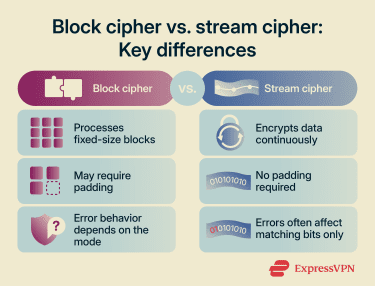
Which cipher type is more secure?
Neither block ciphers nor stream ciphers are automatically more secure. Modern encryption security depends more on the algorithm, implementation quality, key management, and nonce handling than on the cipher category itself.
Outdated algorithms and poor implementation choices create far greater risks than choosing between a block or stream cipher. Weak cipher modes, nonce reuse, insecure key storage, and deprecated algorithms like RC4 or DES can undermine otherwise strong encryption systems.
Most modern security platforms focus on using well-tested algorithms, authenticated encryption, and secure key management rather than prioritizing one cipher type over another.
How to choose between block and stream ciphers
The best cipher type depends on how data moves through a system, the available hardware resources, and the required performance level. Block ciphers generally work best for stored data and enterprise encryption, while stream ciphers often perform better for continuous, low-latency communication.
| Use case | Best choice | Why |
| File encryption | Block cipher | Strong protection for structured and stored data |
| Full disk encryption | Block cipher | Efficient for encrypting large amounts of stored information |
| Real-time voice/video | Stream cipher | Lower latency and continuous encryption |
| Mobile VPNs | Stream cipher (often ChaCha20) | Better software performance on low-power devices |
| Enterprise VPNs | Block cipher (often AES‑GCM) | Widely supported with AES hardware acceleration |
| IoT devices | Stream cipher | Lower computational overhead |
| Database encryption | Block cipher | Strong integrity and authentication support |
| Streaming applications | Stream cipher | Handles continuous data efficiently |
FAQ
Can block ciphers work like stream ciphers?
Why do stream ciphers need unique keys and nonces?
Are stream ciphers still used today?
Why are block ciphers more common in modern systems?
Do block ciphers always require padding?
Which cipher type is better for network communication?
How do cipher modes affect encryption security?